Table of Contents
ToggleBuilding a comfortable outdoor living space starts with the right patio furniture. A quality wood patio furniture set can transform a bare deck or yard into an inviting retreat where you’ll actually want to spend time. Whether you’re a seasoned DIYer looking to refinish pieces or a homeowner shopping for your first set, understanding wood types, maintenance needs, and design principles will help you make choices you won’t regret. This guide covers everything from selecting durable materials to keeping your investment looking sharp for years to come.
Key Takeaways
- Quality wood patio furniture sets made from hardwoods like teak or cumaru can last 15+ years with proper maintenance, while softwoods require more frequent sealing every 1-2 years.
- Teak wood patio furniture offers superior durability and minimal maintenance but costs $2,000–$5,000+, while treated softwood alternatives are budget-friendly at $400–$1,000 with lower initial investment.
- Proper maintenance including annual oiling for hardwoods, regular debris removal, and using breathable furniture covers during off-season is essential to extend your wood patio furniture set’s lifespan from five years to fifteen.
- Measure your patio carefully and allow 3-4 feet of clearance around furniture for traffic flow; a common mistake is oversizing sets that create cramped, uncomfortable outdoor spaces.
- Total cost of ownership matters more than initial price—a premium $2,000 hardwood set with minimal upkeep often costs less over time than a budget $800 set requiring $200 in annual maintenance.
Types Of Wood Patio Furniture Sets Worth Considering
Hardwood Vs. Softwood: Which Is Best For Your Patio?
When shopping for wood patio furniture, you’ll encounter two main categories: hardwoods and softwoods. Even though their names, “hardwood” doesn’t always mean harder to work with, it refers to trees that lose their leaves seasonally (like oak or teak), while “softwood” comes from conifers (like pine or cedar).
Hardwoods are denser and naturally more resistant to rot, insects, and weathering. Teak, cumaru, and ipe are premium hardwoods that can last 15+ years outdoors with minimal treatment. Softwoods like cedar and redwood are lighter, more affordable, and still decay-resistant thanks to natural oils. But, they require more frequent sealing, typically every 1-2 years, to prevent splintering and graying.
For coastal or humid climates, hardwoods win. For DIYers comfortable with annual maintenance and lower budgets, treated softwood works fine. The key is matching the wood type to your climate and maintenance commitment.
Popular Wood Types And Their Durability
Teak tops the durability charts. Its tight grain and natural oil content make it nearly impervious to moisture and insects. A teak set costs $2,000–$5,000+, but with just occasional cleaning, it’ll outlast your home. Teak doesn’t require staining or sealing, though oiling annually preserves color.
Cumaru (Brazilian walnut) offers teak-like durability at 40–50% the cost. It’s dense, rot-resistant, and develops a silvery patina over time if left untreated, or keeps its warm brown tone if oiled annually. Expect $1,200–$3,000 for a solid cumaru set.
Ipe (Brazilian hardwood) is extremely dense and sliver-resistant, ideal if you have pets or barefoot kids. It’s pricier than cumaru but less expensive than teak, roughly $1,500–$3,500.
Cedar and redwood are native softwoods that smell great and are lighter to move. They resist decay naturally but need sealing every 1-2 years. A cedar set might run $800–$2,000 and requires hands-on maintenance.
Treated lumber (pressure-treated pine or fir) is the budget option at $400–$1,000. It resists insects but not as elegantly, you’ll see the green or brown tint from treatment chemicals. Stain it to improve appearance, and expect to re-treat every 2-3 years.
Selecting The Right Size And Style For Your Outdoor Space
Measure your patio or deck before buying. A common mistake is oversizing: a dining set that seats eight looks cramped on a 10′ × 12′ deck. A practical rule is to leave 3–4 feet of clearance around furniture for traffic flow and seating comfort.
Consider how you’ll actually use the space. A conversation set (four chairs plus a side table) needs roughly 8′ × 8′. A dining set (table plus six chairs) requires at least 10′ × 12′. Lounge seating (chaise or sectional) is bulkier but creates a resort feel on larger patios.
Style choices often depend on your home’s architecture. Rustic wood furniture complements cottage or farmhouse homes. Clean-lined, minimalist sets suit modern aesthetics. Curved edges and ornamental details work for traditional properties. Beyond aesthetics, think about scale, oversized pieces can dwarf a small patio, while delicate chairs disappear on a sprawling deck.
Storage and seasonal considerations matter too. If you live where winter arrives, ask whether pieces stack or break down for winter storage. Some sets include covers: factor that into your purchase since UV exposure and winter snow damage wood quickly in off-season months.
Maintenance Essentials: Keeping Your Wood Patio Furniture Looking New
The difference between a patio set that lasts five years and one that lasts fifteen comes down to maintenance. Start with basics: sweep off debris weekly and wipe seats after rain to prevent water pooling, which accelerates rot.
For hardwoods like teak or cumaru, apply teak oil or linseed oil annually (spring is ideal). Use a lint-free cloth, work with the grain, and let it dry fully before use, typically 24 hours. This step refreshes the wood’s natural color and protects against weathering. Skip this, and the wood grays uniformly, which isn’t damage but does signal neglect.
For cedar, redwood, or other softwoods, seal or stain every 1-2 years. Clean the surface with a deck cleaner or diluted bleach solution (1 part bleach to 10 parts water) to remove mildew and algae. Let it dry completely, then apply a water-repellent sealant or outdoor stain. This prevents the wood from absorbing moisture and developing soft spots.
Inspect joints and fasteners annually. Tighten bolts with a wrench if they’ve loosened. Look for splits, especially near armrests and seat backs, these are stress points. If you spot splinters, sand them smooth with 80–120 grit sandpaper before someone gets hurt.
Always use furniture covers during off-season months or prolonged rain. A breathable cover prevents moisture trap while protecting from debris. Avoid plastic tarps that trap humidity and accelerate decay.
Design And Layout Tips For Arranging Your Patio Furniture Set
Arrange furniture to encourage conversation and flow. Grouping chairs and seating in a semi-circle or square creates an inviting gathering spot. A coffee table or side table anchors the arrangement and gives people a place to set drinks.
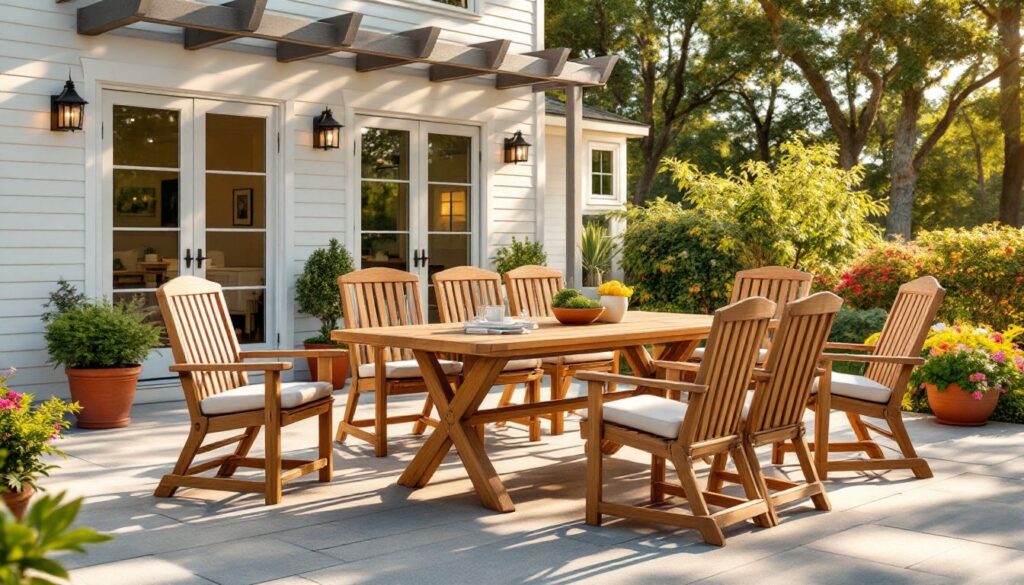
For dining areas, center the table and leave at least 3 feet on all sides for chair pull-out space, people get frustrated if they can’t comfortably sit down and stand up. If your patio is narrow, consider a narrow rectangular table instead of a round one: it uses space more efficiently.
Create zones if your patio is large enough. A dining area at one end and a lounge seating zone at the other lets guests choose their vibe. A shade solution, umbrella, pergola, or sail shade, makes the space usable during peak sun.
Layering with accessories amplifies comfort. Outdoor cushions add color and padding: choose weather-resistant fabrics rated for outdoor use (solution-dyed acrylic or polyester blends resist fading). Planters with native shrubs or perennials soften hard edges. String lights or a tabletop fire bowl extends usability into evening hours.
Balancing visual weight matters. Mix low, open-leg chairs with higher-backed pieces for depth. Avoid lining all furniture against the perimeter, pull at least one seating piece into the space to create intimacy.
Budget-Friendly Versus High-End Wood Patio Furniture Sets
Budget patio sets ($500–$1,500) typically use treated pine or hardwood blends. They’re serviceable and look decent on day one, but expect maintenance demands and shorter lifespans. These sets work if you’re testing whether you’ll use outdoor seating or if you move frequently.
Mid-range sets ($1,500–$3,000) feature teak, cumaru, or quality cedar construction. They balance durability and cost. Many come with warranties (3–5 years) and are backed by established brands. This tier often includes beginner-friendly building guides for customizing or repairing components yourself.
High-end sets ($3,000+) use premium hardwoods with heirloom-grade craftsmanship. Hand-joinery, mortise-and-tenon construction, and solid wood throughout (no veneers) mean pieces can be refinished indefinitely. A $5,000 teak set might outlive your children if cared for properly.
Consider total cost of ownership. A budget set at $800 that needs $200 in maintenance per year over eight years costs $2,400 total. A hardwood set at $2,000 with minimal maintenance spreads the cost over a longer lifespan, often favoring the premium option. For specific design inspiration and woodworking project plans, research retailers and manufacturer specifications.
Buy during shoulder seasons, late fall or early spring, when retailers discount inventory. Online sales often beat showroom prices, but confirm return policies and shipping costs (patio furniture is heavy).